Trading psychology fundamentals
How to Control Your Emotions in Trading
You cannot remove emotions from trading, but you can keep them out of your decisions. Set your risk rules before the session, check how ready you are to trade, and have a plan for the minute after a loss. At the close, note which emotion showed up and whether you followed your rules.
Key takeaways
- You cannot switch emotions off. Research on suppression suggests hiding a feeling does not reduce it.
- Decide your risk limits before the session, so the emotional moment has fewer choices in it.
- During the session, name the emotion and rate it from 1 to 10 before the next order.
- The trading emotions cycle is a teaching picture of feelings, not a timing tool.
- At the close, review which emotion showed up, not only your P&L.
How do you control emotions in trading?
You control them by giving them less to decide. Most emotional trades happen when a big decision is left open until the worst moment: how much to lose today, whether to take the next trade after a loss, whether to chase. Close those questions before the session, and the emotion has fewer places to go.
Think of it in three parts.
| When | What you do | Why it helps |
|---|---|---|
| Before the session | Write your loss limit, trade cap and one if-then rule | The hardest choices are made while you are calm |
| During the session | Name the emotion, rate it, pause before the next order | You notice the feeling before it places a trade |
| After the session | Note which emotion showed up and whether you kept your rules | Patterns become visible over a few weeks |
The rest of this guide takes each part in turn. For the bigger picture of why traders break their own rules, start with the trading psychology guide.
Can you remove emotions from trading?
No, and trying to is part of the problem. Lo and Repin (2002) measured the skin conductance, pulse and other physical signals of 10 professional traders during live trading. They found significant responses during market events and volatile periods. Even full-time traders feel the market in their body.
Pushing the feeling down does not work well either. In a review of emotion research, Gross (2002) found that suppression, hiding a feeling, reduced how much it showed but not how much it was felt, and it raised physiological responding. Reappraisal, changing how you read the situation, did lower the feeling. Those studies were not about trading, but the lesson carries over: "stop feeling it" is a weak plan.
What the trading research does suggest is that intensity matters. In Lo, Repin and Steenbarger's (2005) study of 80 day traders, those with more intense reactions to gains and losses did significantly worse. That is a correlation, not proof of cause. So the realistic goal is not zero emotion. It is lower intensity, noticed early, with rules that do not depend on your mood.
That is also the honest answer to "how do I trade with discipline and without emotion". You trade with discipline and with emotion, using rules written before the emotion arrived.
What is the trading emotions chart?
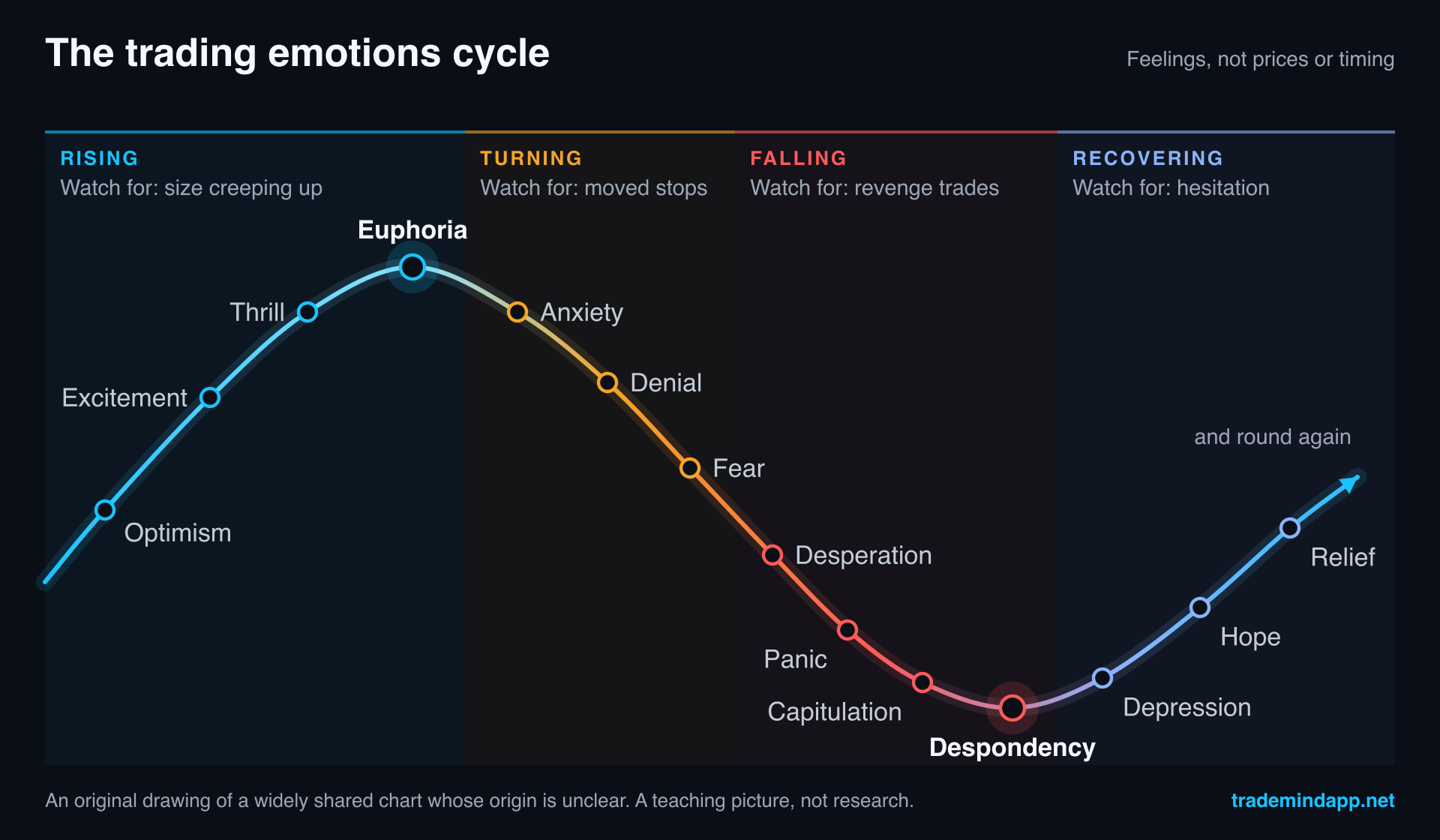
The trading emotions chart is a curve that tracks how a trader's feelings swing through a cycle: optimism and excitement on the way up, euphoria at the top, then anxiety, fear and panic on the way down, and hope and relief on the way back. Versions of it are shared widely on trading sites, but its origin is unclear and it is not based on a study.
It is still a useful mirror. Each stretch of the cycle tends to come with a typical mistake, and naming where you are can stop you from making it.
The trading emotions cycle
Fourteen feelings many traders recognise, from optimism to euphoria, down to despondency and back. The bands name the mistake to watch for at each stretch.
Rising · stages 1-4
- Optimism
- Excitement
- Thrill
- Euphoria
Watch for: Wins make the next trade feel easy. Position size creeps up and trades outside the plan start to look fine. Guide: Greed in trading
Turning · stages 5-7
- Anxiety
- Denial
- Fear
Watch for: The first pullback gets explained away. Stops get moved and losing trades are held because they will come back. Guide: Fear in trading
Falling · stages 8-11
- Desperation
- Panic
- Capitulation
- Despondency
Watch for: The urge to win it back, oversized trades after a loss, or selling everything at once to make the pain stop. Guide: Revenge trading
Recovering · stages 12-14
- Depression
- Hope
- Relief
Watch for: Valid setups get skipped, and winners are cut early just to feel safe again. Guide: Fear in trading
| Stretch | Feelings | Typical mistake | What to do |
|---|---|---|---|
| Rising (1-4) | Optimism, excitement, thrill, euphoria | Size creeping up, targets moving | Keep size as planned; see greed in trading |
| Turning (5-7) | Anxiety, denial, fear | Moving stops, holding losers | Exits set before entry; see fear in trading |
| Falling (8-11) | Desperation, panic, capitulation, despondency | Revenge trades or dumping everything | Follow your post-loss plan and your stop-for-the-day rule |
| Recovering (12-14) | Depression, hope, relief | Skipping valid setups, cutting winners early | Small risk and a pre-trade check |
Note
The chart maps feelings, not prices or timing. Real sessions skip stages, repeat them or stop halfway. Never use it to predict what a market will do next.
Which emotions break trading plans?
The guides on this site group plan-breaking emotions into seven patterns. Each one pushes you towards a specific mistake.
| Emotion | What it pushes you to do | Pattern | Guide |
|---|---|---|---|
| Anger or frustration after a loss | Win it back now, bigger | Revenge trading | After a losing trade |
| Anxiety about missing a move | Chase a late entry | FOMO | FOMO |
| Fear of losing | Hesitate, move stops, cut winners | Fear | Fear in trading |
| Boredom or restlessness | Take trades that are not in the plan | Overtrading | Overtrading and boredom |
| Overwhelm after several losses | Stop following rules at all | Tilt | Trading tilt |
| Euphoria after wins | Size up, move targets | Greed | Greed in trading |
| Doubt after a drawdown | Skip trades, change rules mid-week | Not trusting your system | Trading discipline |
Losses tend to hit hardest. Kahneman and Tversky's (1979) prospect theory describes a value curve that is steeper for losses than for gains: losing $500 feels bigger than winning $500. That is one reason the first three rows all start with a loss or the fear of one.
Before the session: how do you take decisions out of the moment?
- Write your daily loss limit. The number at which you stop for the day, decided now. See how to set a daily loss limit.
- Write your trade cap. The most trades you will take today.
- Write one if-then rule. Aim it at your weakest moment: "If I take two losses in a row, then I step away for ten minutes." Gollwitzer and Sheeran (2006) pooled 94 tests of if-then plans and found a medium-to-large effect on reaching goals. The studies were not about trading, so treat that as a reason to try it.
- Rate your state. Sleep, stress and mood, each from 1 to 10. Decide in advance what a low score means, for example fewer trades or no trading.
- Run a short pre-market routine. A trading checklist keeps it the same every day.
During the session: how do you name it, rate it and pause?
When you notice a strong feeling, the next order is the risk. This takes under a minute.
- Hands off. Take your hand off the mouse. No new order until step 4.
- Name it in one word. Angry, scared, bored, excited, desperate.
- Rate it from 1 to 10. Write the number down.
- Check it against your rule. Decide in advance what score means "step away". If you are over it, follow your if-then rule.
- Run your pre-trade check. Is this setup in my plan, where am I wrong, and would I take it if the last trade had not happened?
Naming a feeling is more than a ritual. In a brain-imaging study, Lieberman and colleagues (2007) found that putting a word to the emotion in a picture lowered the response of the amygdala, a region involved in threat and emotion. It was a lab task with pictures, not trading, so treat it as a reason to try the habit rather than proof that it works at the desk.
If the feeling comes from a loss, do not improvise. The step-by-step plan for that moment is in what to do after a losing trade.
How do you stay calm while trading?
Staying calm is mostly preparation, plus a physical reset you can use in seconds.
- Breathe out longer than you breathe in. In a 28-day study of 108 adults, five minutes a day of exhale-focused cyclic sighing improved mood more than mindfulness meditation. Box breathing did not differ significantly from meditation in that study (Balban et al., 2023). A review of 15 studies of slow breathing, under 10 breaths a minute, found links with more relaxation and less anxiety, but the studies varied too much to pool (Zaccaro et al., 2018). Slow breathing may help you feel calmer; it is not a treatment.
- Change your body position. Stand up after a loss or a rule break. Walk away from the screen for a set time.
- Reduce the noise. Fewer charts, fewer alerts and no chat rooms during your trading window. If your platform lets you, hide the running P&L so you watch price and your plan instead.
- Start calm. A short routine before the open is easier than getting calm back mid-session.
The breathing reset has a guided timer you can practise with outside market hours.
Warning
If you feel anxious, low or unable to stop thinking about trading even when markets are closed, that is more than a trading problem. Read trading stress and burnout, which lists where to get help.
After the session: how do you review emotions, not only P&L?
Your P&L tells you what happened. Your emotions tell you why. Spend five minutes after the close on these questions:
- Which emotion showed up most today, and when?
- Did it change a decision: a trade, a size, a stop or an exit?
- Did I keep my loss limit, my trade cap and my if-then rule?
- What would I do differently at that moment tomorrow?
Tag each entry with one emotion word. After a few weeks, sort by tag and look for repeats: the same emotion at the same time of day, or after the same kind of trade. The emotional trading journal guide has more prompts.
Where does TradeMind fit?
TradeMind: Trading Psychology, the iPhone trading psychology app (App Store ID 6761249038) by Nikolaos Aristotelis Adamidis, puts the before, during and after routine on your phone. What each tool does:
- Journal. Write an entry or record a voice note and tag it Calm, Focused, Anxious, Greedy or Revenge. See the journal and toolkit.
- The TradeMind Tilt Protocol. In the moment, you pick one of 5 states (Revenge, FOMO, Fear, Boredom, Tilted), rate it from 1 to 10, then read 6 short cards over a live front-camera mirror that records nothing. You finish by tapping "I chose to resist" or "I tilted".
- The TradeMind Trader Readiness score. A 0-100 self-reflection score built before your first trade: 40 for signing the TradeMind Daily Pledge, 30 for a completed mindset routine, up to 30 for your own pre-market checklist, and 5 more when your streak is over 3 days. Each resisted tilt adds 5; each tilt you act on takes 20 away and caps the day at 50. Without a pledge the score cannot go above 60. It measures preparation, not how you feel.
- Resets. Pre-Session Focus is 1 minute of centering, 2 minutes of resonance breathing (4 in, 6 out) and 3 minutes of visualising a trade going against you. Reset After Loss is the STOP method (30 seconds), 2 minutes of box breathing and a 1-minute reality check.
- Dr. Noesis, the AI coach inside TradeMind: Trading Psychology. It asks follow-up questions about what you felt and why. It is an AI built on Google Gemini, not a therapist; it does not read charts or give buy or sell advice, and chats are not saved between sessions.
TradeMind does not connect to your broker and does not know your trades unless you write them down.
Frequently asked questions
How do I stay calm while trading?
Prepare so there is less to decide, and have a physical reset ready. Set your loss limit and trade cap before the open, keep your breathing slow with a longer exhale when you feel pressure, and stand up and step away after a loss or a rule break. Calm is easier to keep than to get back, so start the session with a short routine.
Where does the trading emotions chart come from?
Its origin is unclear. Versions of the cycle of market emotions circulate on broker and trading-education sites without a clear first source. Treat it as a teaching picture of how feelings tend to swing, not as research.
Can the emotions cycle tell me where the market is going?
No. The chart maps feelings, not prices or timing. Real sessions skip stages, repeat them or stop halfway. Use it to name what you feel and the mistake that usually comes with it, never to predict a move.
Is it normal to feel emotional when trading?
Yes. In a study of 10 professional securities traders, Lo and Repin measured clear physiological responses, such as changes in skin conductance and heart activity, during live market events and volatile periods. Feeling something is normal. The goal is to keep the feeling from changing your plan.
Sources
- Fear and Greed in Financial Markets: A Clinical Study of Day-Traders (opens in a new tab)80 day traders surveyed daily for five weeks. More intense emotional reactions to gains and losses went with significantly worse trading performance. Correlational.
- The Psychophysiology of Real-Time Financial Risk Processing (opens in a new tab)Skin conductance, pulse and other measures in 10 professional traders during live trading. Significant responses during market events and high volatility. Very small sample.
- Emotion regulation: Affective, cognitive, and social consequences (opens in a new tab)Review of lab and individual-difference studies. Reappraisal lowered emotional experience; suppression hid its expression but did not lower the experience and raised physiological responding. General population, not traders.
- Putting Feelings Into Words: Affect Labeling Disrupts Amygdala Activity in Response to Affective Stimuli (opens in a new tab)Brain-imaging study: labelling the emotion in a picture lowered amygdala response compared with other ways of processing it. A lab task with images, not traders.
- Implementation Intentions and Goal Achievement: A Meta-analysis of Effects and Processes (opens in a new tab)94 independent tests: if-then plans had a medium-to-large effect on reaching goals (d = .65). General goals, not trading.
- Prospect Theory: An Analysis of Decision under Risk (opens in a new tab)The value function is steeper for losses than for gains. Choice experiments, not traders.
- Brief structured respiration practices enhance mood and reduce physiological arousal (opens in a new tab)108 adults, 5 minutes a day for 28 days. Only exhale-focused cyclic sighing improved positive mood significantly more than mindfulness meditation; box breathing did not differ significantly.
- How Breath-Control Can Change Your Life: A Systematic Review on Psycho-Physiological Correlates of Slow Breathing (opens in a new tab)Review of 15 studies of slow breathing (under 10 breaths a minute) in healthy people. Methods varied too much for a meta-analysis.
Related guides
Educational only, not financial advice. TradeMind: Trading Psychology does not tell you what to buy or sell, and nothing on this page is a recommendation to trade. Trading involves risk of loss.